Identifying the Construct and Setting the Estimand
Psychological Scale Construction
2026-10-14
Agenda
- What your group has to produce today
- The kind of literature review that helps scale construction (and the kind that does not)
- How to write a construct definition you can actually use
- Construct boundary: what is excluded, and sibling constructs
- Estimand: which quantity, in whom, under what conditions
- From construct definition to operational definition
What your group has to produce today
What changes from today
The first seven sessions covered what you need to know. From now on, all of it becomes decisions your group has to make.
Today has only a short lecture. Most of the time is for group work.
What you produce today will be used all the way to Session 15.
The workflow
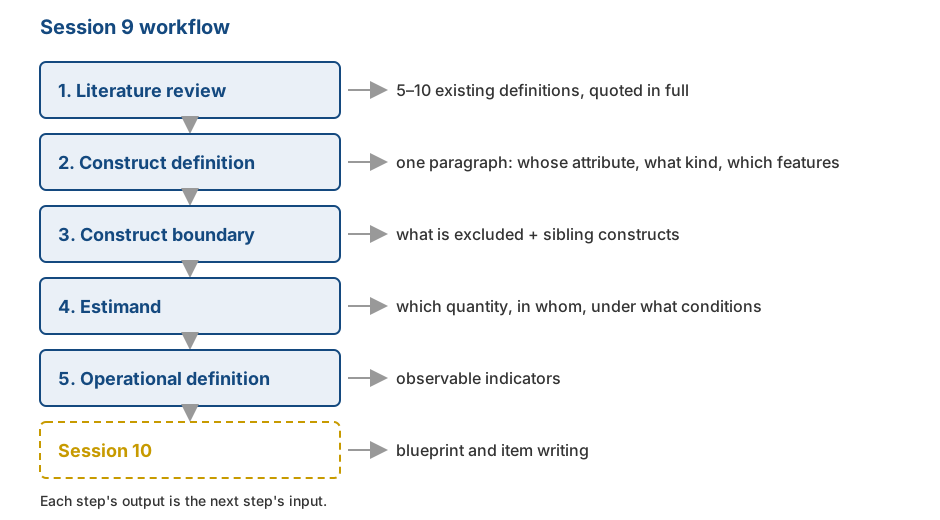
Why this step gets skipped
Many reports begin directly with “we adapted scale X”. The construct definition is never written, because it is assumed to be obvious.
DeVellis calls this “deceptively obvious”.
- Many researchers believe they have a clear idea, then discover the description of the construct was very abstract, usually after items have been written and data collected.
At that point, fixing it is far more costly than it would have been at the start.
Step 1: literature review
Not the usual kind of review
You are not summarising all the research on the construct you have chosen.
What you are looking for is narrow: how other people define this construct, and where those definitions differ from one another.
The target is simple: 5 to 10 definitions, quoted in full, with their sources.
If you want to go deeper and work more systematically, try the construct profiling template built for another course (Data Literacy and Academic Writing, MA Psychology).
How to record them
Make a three-column table: source, definition (quoted exactly), what it emphasises. Do not paraphrase yet: the differences between definitions often lie in the exact wording.
What to look for in the table
Points of agreement. Which elements appear in nearly every definition? Those are probably the core of the construct.
Points of disagreement. Which elements appear in only some? That is where you have to take a position.
What nobody mentions. Sometimes an obviously relevant aspect appears in no definition at all.
- That can be your group’s contribution, as long as you say so openly.
Recall Fried’s (2017) finding from Session 1: seven depression scales contained 52 different symptoms. Disagreement between definitions is common.
Step 2: writing the construct definition
Three things it must state
A usable definition names:
Whose attribute this is. An individual? A group? A couple? An organisation?
What kind of thing it is. A relatively stable trait, a momentary state, an ability, an attitude, a belief, or a pattern of behaviour?
Its essential features. What must be present for something to count as this construct?
On “whose attribute”
We covered this in Session 3: a latent variable is usually a characteristic of whoever supplies the data.
If you ask students to rate their lecturer, you are measuring students’ perceptions, not the lecturer’s qualities.
If you ask parents to report their child’s behaviour, you are measuring the parents’ report, not the child’s behaviour directly.
Check this
The construct name in your report must match who actually completed the questionnaire. A mismatch here will carry through the report.
Common faults
| Definition | The problem |
|---|---|
| “Academic anxiety is anxiety experienced in academic contexts.” | Circular. The word being defined reappears inside the definition. |
| “Academic anxiety is the score on the Academic Anxiety Scale.” | Names an instrument, not a meaning. This is an operational definition in the wrong place. |
| “Academic anxiety is discomfort related to university study.” | Too vague. “Discomfort” could mean almost anything. |
| “Academic anxiety is a disorder that harms students.” | Evaluative. A definition says what something is, not whether it is good or bad. |
How specific?
The level of specificity of a construct is your decision, tailored to the research purpose (when the scale is used for empirical research), not something that emerges on its own.
DeVellis’s example: locus of control.
- Rotter (1966) framed it generally.
- Levenson (1973) separated three loci.
- Wallston et al. (1978) made it health-specific. A later version can be narrowed even further, to a single illness.
All three can be useful. What determines which is right is the research question.
A useful rule
Measures relate most strongly to each other when their levels of specificity match. A very general scale will not predict a very specific behaviour well, and the reverse is also true.
Step 3: the construct boundary
Naming what is excluded
We have raised this since Session 1: stating what is not included does more for a scale’s quality than stating what is.
Without a clear boundary, scale content easily drifts into territory you did not intend, and your scores become contaminated by construct-irrelevant variance.
How to do it
Write two lists side by side: included and excluded. Fill both with concrete examples, not abstract categories.
Sibling construct
For each similar construct, write one sentence: how is it different from mine?
Example: social anxiety and shyness.
- Both involve discomfort in social situations.
- The difference lies in fear of negative evaluation and in the degree of avoidance.
If you cannot write down the difference, you probably cannot separate them through items either.
Two classic errors
- Jingle fallacy — assuming two things are the same because they share a name.
- Two scales that both claim to measure “resilience” or “depression” can measure very different things.
- Jangle fallacy — assuming two things differ because they have different names.
- “Grit” and “conscientiousness” correlate very highly despite the different labels.
Step 4: setting the estimand
A term borrowed from elsewhere
In quantitative research, an estimand is the quantity you want to know, stated before any method is chosen.
Lundberg, Johnson, & Stewart (2021) argue that much research skips this step: the method is chosen first, and the meaning is constructed afterwards.
The same idea is useful for measurement. Before writing a single item, state which quantity you want to estimate.
Four questions
Which quantity? A person’s level of it? Their standing relative to others? The presence or absence of a condition?
In whom? The target population must be named specifically: not “the public”, but for instance “enrolled undergraduates in Surabaya, aged 18–24”.
Under what conditions? Are you measuring a present state, a general tendency, or experience within a particular period?
Compared with what? Will scores be interpreted relative to other people (norms) or against a fixed standard (criterion)?
An example estimand
We want to estimate the level of social anxiety experienced over the past month among enrolled undergraduates aged 18–24 in Surabaya, interpreted relative to the score distribution of that group.
Notice how much this one sentence settles: the time frame in the items, the pilot population in Session 12, and the form of the norms in Session 14.
It also closes off claims you have not tested.
- Your scale does not apply to secondary school students or to employees, and you have said so from the start.
This sentence is the hardest part of today’s work. If your group can write it clearly, the rest of the semester becomes considerably easier.
How it connects to other sessions
| Part of the estimand | Determines |
|---|---|
| Which quantity | Response format (S4–5) and the form of the score |
| In whom | Pilot sample (S12), between-group checks (S13) |
| Under what conditions | The time frame in item wording (S10) |
| Compared with what | The form of norms and standard scores (S14) |
Step 5: the operational definition
Its job is to bridge
The construct definition says what you mean. The operational definition says how that shows up in something observable.
It consists of indicators: concrete behaviours, thoughts, or feelings that signal a high level of the attribute.
These are not yet items. Items come in Session 10, built from these indicators.
Example
Construct: social anxiety
Facet: fear of negative evaluation
Indicators: worrying about seeming foolish when speaking; replaying conversations afterwards; avoiding asking questions in class even when confused
Item (Session 10): “After speaking in front of the class, I replay what I said in my head.”
Each indicator should yield more than one item. Recall from Session 6 that the number of items affects reliability, and from Session 7 that content coverage affects the validity of score interpretations.
Dimensional structure
Now state it: is your construct unidimensional or multidimensional?
If multidimensional, name the dimensions and explain how they relate to one another.
State also whether you treat it as dimensional/a continuum or categorical.
Group work
Today’s tasks
15 minutes — Collect existing definitions. At least five, quoted in full with sources.
20 minutes — Write your group’s construct definition. One paragraph, containing the three elements above.
20 minutes — Build the two lists: included and excluded. Add two sibling constructs and how yours differs.
20 minutes — Write one estimand sentence answering the four questions.
20 minutes — Set out facets and indicators. At least two indicators per facet.
Brief presentations
Each group presents two things only, one minute each:
Your estimand sentence.
One sibling construct and how yours differs from it.
Other groups may ask one question: “what makes you confident your items will not also measure that sibling construct?”
What you must produce
The construct specification
One page, containing:
- Construct definition — one paragraph, with references.
- Construct boundary — the included and excluded lists.
- Sibling constructs — if any, with the distinctions.
- Estimand — one sentence.
- Dimensional structure — one or several dimensions, and why.
- Facets and indicators — as a table.
This specification becomes an appendix to your final report, and the material the expert panel reads in Session 11. The panel cannot judge item relevance without first reading the construct definition.
For Session 10
- We build the blueprint: how many items per facet, and why that many.
- We write items, using the principles covered in Sessions 4 and 5.
- The most common item-writing faults: double-barrelled items, convoluted sentences, sentences that lean normative (judgemental), and badly designed unfavorable items.
- Bring your group’s construct specification.
Preparation
Read DeVellis & Thorpe (2022), Chapter 5, the sections on item writing.
Thank you!😊
Questions?
- amelia.zein@psikologi.unair.ac.id
- https://rameliaz.github.io/
- @rameliaz
- @rameliaz
- @rameliaz
These slides were made using and Quarto, with a template from UNAIR Theme.
References
DeVellis, R. F., & Thorpe, C. T. (2022). Scale development: Theory and applications (5th ed.). SAGE.
Flake, J. K., & Fried, E. I. (2020). Measurement schmeasurement: Questionable measurement practices and how to avoid them. Advances in Methods and Practices in Psychological Science, 3(4), 456–465.
Fried, E. I. (2017). The 52 symptoms of major depression. Journal of Affective Disorders, 208, 191–197.
Kelley, T. L. (1927). Interpretation of educational measurements. World Book.
Levenson, H. (1973). Multidimensional locus of control in psychiatric patients. Journal of Consulting and Clinical Psychology, 41(3), 397–404.
Lundberg, I., Johnson, R., & Stewart, B. M. (2021). What is your estimand? Defining the target quantity your research question aims to answer. American Sociological Review, 86(3), 532–565.
Podsakoff, P. M., MacKenzie, S. B., & Podsakoff, N. P. (2016). Recommendations for creating better concept definitions in the organizational, behavioral, and social sciences. Organizational Research Methods, 19(2), 159–203.
Rotter, J. B. (1966). Generalized expectancies for internal versus external control of reinforcement. Psychological Monographs, 80(1), 1–28.
Wallston, K. A., Wallston, B. S., & DeVellis, R. (1978). Development of the Multidimensional Health Locus of Control (MHLC) scales. Health Education Monographs, 6(2), 160–170.