Stages of Cognitive Test Development
Cognitive Test Development
2026-09-23
Agenda
- Order of work: write items first, or plan first?
- 11 stages, 4 phases of development
- Planning Phase: construct definition and blueprint
- Item Development Phase
- Empirical Testing Phase
- Finalization Phase
- The iterative nature of the process
The order of writing items
Your group has just been given an assignment
Develop a numerical aptitude test for job-training applicants. What should you do first?
- Most people start by writing arithmetic questions, without first drafting a construct definition or blueprint.
- Within an hour, they’ve usually collected around 20 items.
- The problem only becomes visible once those items are tried out: the domain represented is unclear, the proportions are unbalanced, and the content validity is hard to defend.
The consequence of this order
Writing items is often treated as the most important activity, while defining the construct and drafting the blueprint are seen as mere administrative steps. But this order determines whether the items you write rest on a defensible foundation.
There’s no fixed recipe
Many versions exist, but the logic is the same
- Kline (1986) laid out his own set of stages.
- Azwar (2019) has a slightly different order.
- Downing (2006), in the Handbook of Test Development, spells out twelve steps for large-scale testing.
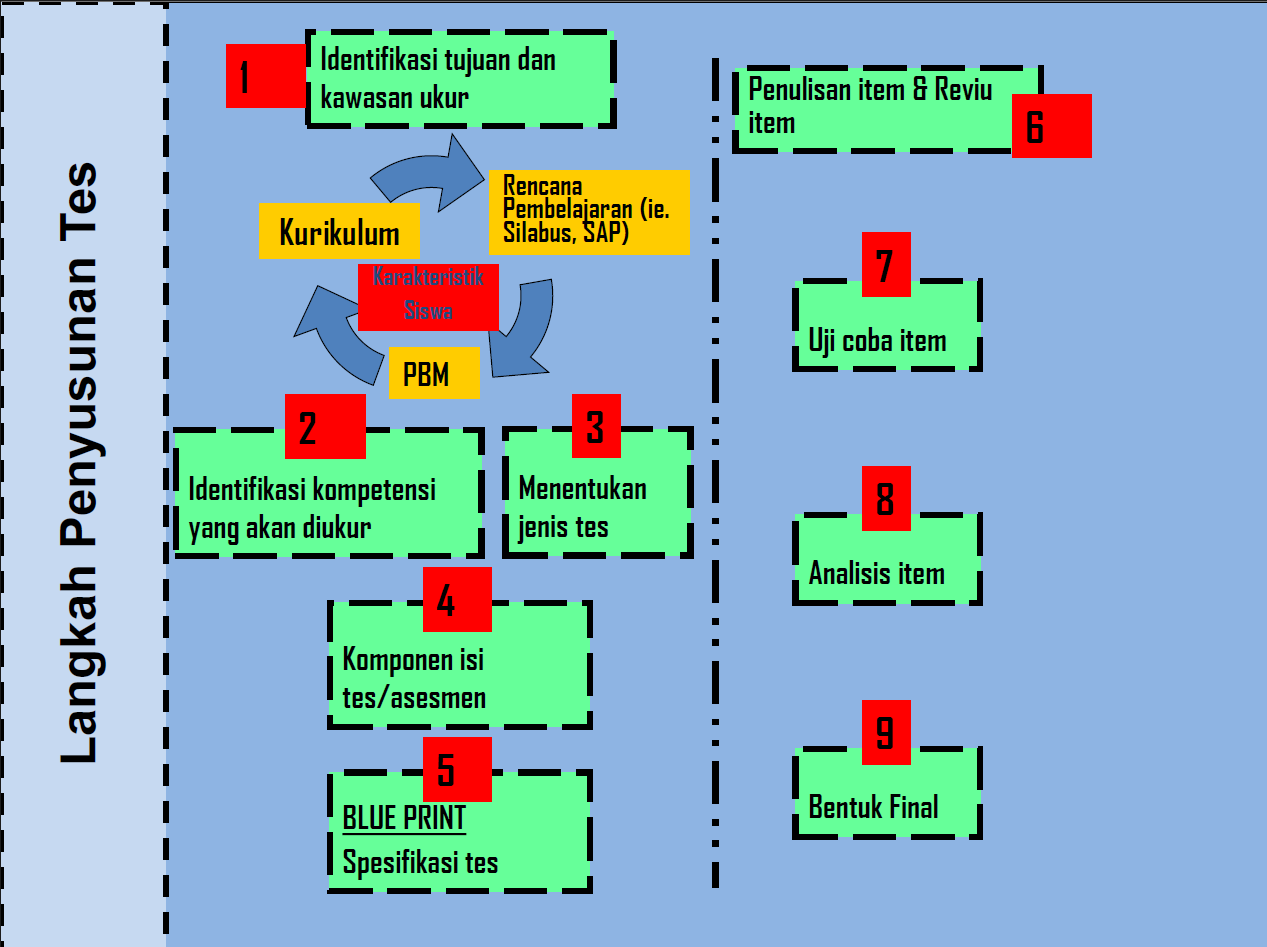
- The details differ, but the overall logic is the same: plan first what and how you want to measure, develop the items, test them empirically, then finalize.
What we use in this course
We use a synthesis of eleven stages grouped into four broad phases. This is not the only “correct” way to do it, but it’s what will guide your group project from Meeting 9 through Meeting 14.
1️⃣1️⃣ stages, 4️⃣ phases
The big picture
| Phase | Stages | In this course |
|---|---|---|
| A. Planning | 1–4 | Meetings 9–10 |
| B. Item Development | 5–6 | Meeting 11 |
| C. Empirical Testing | 7–9 | Meetings 12–13 |
| D. Finalization | 10–11 | Meeting 14 |
Phase A: Planning
Stages 1–2: purpose and construct
- Identify the purpose and scope of the construct being measured — what will this test be used for, and with what population?
- Define the construct — what exactly is being measured, formulated operationally based on theory.
A stage that’s often skipped
Many people tend to skip Stage 2 because it seems “obvious.” Everyone feels they know what “numerical ability” means. But without an explicit operational definition, there’s no basis for deciding which items belong and which don’t belong in the test. This is the construct operationalization concept you already learned in Psychometrics.
Stages 3–4: test type and blueprint
- Determine the type of test — is this an achievement test, an aptitude test, or an intelligence test? (Meeting 1 is relevant again here.)
- Draft the test specification/blueprint — the proportion of items for each sub-domain, and how many items in total.
A simple blueprint example
A numerical aptitude test with 3 sub-domains, 20 items:
| Sub-domain | Proportion | Number of items |
|---|---|---|
| Basic arithmetic operations | 40% | 8 |
| Number series/patterns | 30% | 6 |
| Quantitative word problems | 30% | 6 |
A blueprint also typically crosses content domains with the cognitive level to be measured, which we’ll cover in more depth in Meeting 3 through the taxonomy of instructional objectives.
Phase B: Item Development
Stages 5–6: writing and review
- Item writing — following the proportions and cognitive levels already set in the blueprint, not the item writer’s personal preferences.
- Expert review — items are examined by another party (ideally someone who understands the construct) before being tried out, as initial evidence of content validity.
The function of the review stage
Item writers often don’t notice problems in the items they wrote themselves — ambiguous wording, multiple correct answers, or culturally biased cues, for example. Review by another party becomes the first check before items are used with actual participants.
Phase C: Empirical Testing
Stages 7–9: from data to evidence
- Try-out — items are administered to a sample representative of the target population.
- Item analysis — examining the difficulty level and discrimination index of each item from the try-out data.
- Reliability and validity estimation — calculated from the item analysis results and the items retained.
The function of this stage
These three stages are the part of the process where test quality is examined based on empirical data. This part will be covered further in Meetings 12–13.
Phase D: Finalization
Stages 10–11: norms and manual
- Norm development — converting raw scores into scores that can be meaningfully interpreted (deciles, percentiles, standard scores) relative to a reference group.
- Test manual preparation — complete documentation on how to administer, score, and interpret the test.
This is your Assignment 3 output
The test booklet (containing the items that passed selection) and the test manual you submit in Meeting 14 are Stages 10 and 11.
The iterative nature of the test development process
Repetition across stages
- These eleven stages are depicted linearly, but in practice you often need to go back to an earlier stage.
- Item analysis shows an imbalance of items in one sub-domain → go back to Stage 5 to write replacement items, sometimes back to Stage 4 to revise the blueprint.
- Reliability turns out too low → this may mean going back to item writing.
Consequence for your project timeline
Set aside time for the possibility of returning to an earlier stage. Groups that work through each stage only once, with no revisiting, tend to run into time pressure in Meetings 13–14.
Summary of the Test Development Stages
Summary
- Writing items without first defining the construct and blueprint is a common mistake that risks producing domain proportions that don’t match the plan.
- There are many versions of these stages in the literature (Kline, 1986; Azwar, 2019; Downing, 2006)).
- This course’s eleven stages are grouped into four phases: Planning, Item Development, Empirical Testing, Finalization.
- The process is iterative — set aside time to return to earlier stages.
For Meeting 3
Coming up: taxonomy and instructional objectives
The blueprint we touched on today crosses content domains with cognitive level. Meeting 3 covers the taxonomy that underlies how that cognitive level is determined — a tool you’ll use directly when drafting your project’s blueprint.
Thank you!😊
Any questions?
These slides were prepared using and Quarto with a template from UNAIR Theme.
References
Azwar, S. (2019). Konstruksi tes: Kemampuan kognitif. Pustaka Pelajar.
Downing, S. M. (2006). Twelve steps for effective test development. In S. M. Downing & T. M. Haladyna (Eds.), Handbook of test development. Lawrence Erlbaum Associates.
Kline, P. (1986). A handbook of test construction: Introduction to psychometric design. Methuen.